back in oct 2012, i have written in this blog about velocity of money while many readers may still struggle on the abstract meaning of it, now in this particular writing, i will visualize it with more clarity but it might not sound right to economists.
some readers should have heard of my arguments and explanation at dinner or lunches and may not need to read further, but you can pass it on to your friends.
gdp stands for gross domestic product, thus it is something serviced or produced less intermediary costs. a more simple way is price x quantity produced/serviced [we will use the term produce hereafter].
so why is money printing so important to usa?
P x Q, what if quantity drops faster than price rises, then you have an economic contraction. a simple example if P=10, Q=100, price goes up 20%, quantity drops 20%, most of you would think that it should even out, it doesnt 12*80=960 which is smaller than 1000 by 4%.
usa is using money printing to fend off the sharp drop in quantity since 2008, prices must rise faster than quantity drops to maintain parity not to mention if you want growth. in the above case, it takes 25% increase in price to get even.
in the us, they have the mentality to lower the cost of debt by not paying for interest, paying back with far less value 10 years down the road. if you know rule of 72/i where i is compound interest rate, value will double in 10 years with i=7 and 7 years with i=10.
why is there no inflation according to measure - because the inflation is focused in food and fuel only, other items are discretionary and would be forced out of the daily budget of layman. if there is no/low demand for say jeans the quantity will drop sharply and any price increase cannot offset the drop in gdp. other factors such as robust economy, a young population which contributes to the high inflation of the 80s just are not there. in fact the aging population and the weak economy contributed to the low inflation environment [of items other than food and fuel].
every time price increases for food and fuel, it squeezes other sectors, the drop in quantity requires faster price increases to get even. this is one reason you see such urgent QE even it is so close to us election.
this is why you see china's economy is not as robust, it could become weaker without intervention. aud is another indicatior of slow chinese economy ahead.
recent oil prices pointed to stagnant or falling demand, but the drop in supply from Saudi subsequently jack up prices, gold also signal very little inflation ahead. cad is a precursor indicator of gold and oil prices, it is also getting nowhere.
go through the thinking above if you want to know the macro view of the global economy.
06 February 2013


17 January 2013
2013 Trends
a worth reading article from washington post. pay attention to item 8 in red.
10 trends to watch in
finance for 2013
By Barry Ritholtz, Published: January 13
It’s a winter ritual: Seers,
prognosticators and other gurus tell us which stocks to buy for the year ahead,
where they think the Dow will close in December and which momentous events will
take place.
History teaches us that the majority
of these charlatans will be wrong, and the ones who get it right are mostly
lucky. If you have been reading my column for any length of time, you know to
ignore them. (See 2011’s Forecaster
Folly.)
When it comes to predictions, I do
the following: Note down the forecasts made this month and look back at them in
a year. Repeat every year. I use my desktop calendar and an e-mail Web service
called Followupthen.com to keep me on track. I started doing this almost a
decade ago, and I found it terribly liberating. It will be always be
instructive, and, as with the class of 2008 forecasters, occasionally hilarious.
Doing this taught me to ignore the
forecasts I see or read, as well as to keep the piehole in the middle of my
face closed whenever anyone asks me for a forecast. I defer, saying, “I have no
idea. No one does.” It is fun to watch the TV anchors’ heads spin like Linda
Blair’s in “The Exorcist.”
A better use of your time? Discern
what’s happening here and now. It’s been my experience that investors spend so
much time worrying about what might come next that they miss what just
happened.
To that end, let’s look at what’s
driving the world of finance. Major shifts have already taken place, and if you
understand what they are, it will help your financial planning. From my perspective,
these are the more significant trends that will probably continue into 2013:
1. ETFs are eating everything.
The revenge of John Bogle continues
apace. As investors figure out that they are not good at stock-picking or
managing trades, they have also learned that most professionals are not much better.
Paying high mutual fund expenses to a manager who underperforms a benchmark makes
little sense.
This realization has led to the rise
of inexpensive exchange-traded funds and indices. This “ETFication” has obvious
advantages: low costs, transparency, one-click decision-making.
ETFs are accessible through the stock
market for easier execution, with no minimum investment required. Even bond
giant Pimco recognized this trend and created an ETF version of Bill Gross’s
flagship vehicle, the Total Return Fund. Pimco actually charged more for the ETF
than its mutual fund to prevent an exodus of investors from the world’s largest
bond fund. This will eventually shift.
Note that Bloomberg, Yahoo Finance
and Morningstar all have robust ETF sites that are free (Morningstar charges
for some data).
2. The financial sector continues to shrink; advisers continue to
leave large firms for independents.
Since the financial crisis, Wall
Street has shrunk considerably. According to the Bureau of Labor Statistics,
there were about 7.76 million people employed in finance and insurance as of November.
That’s down almost 10 percent from the pre-crisis 2007 peak of about 8.4
million workers.
Its more than the crisis: Technology
and productivity gains make it easier to operate with fewer
workers. My office is a perfect
example: Twenty years ago, it would have taken a huge staff to manage the
assets we run, handle all the administrative functions, take care of the
monthly reporting and manage compliance. What would have taken two dozen people
in the 1980s is easily managed by five people today. Oh, and everyone in the
office is required to do research or publish commentary. That would have been
impossible 30 years ago.
Over the past 40 years, the financial
sector over-expanded. Much of what is happening on Wall
Street now reflects the process of
reversing that excess capacity.
3. Increased pressure on fees and commissions.
This trend predates ETFs and Wall
Street shrinkage; highly paid people are being replaced with cheap software and
online services. This is likely to continue for the foreseeable future.
This is a very good thing for
investors: Academic studies have shown that fees are a drag on returns, and
lowering these costs is a risk-free way to improve your returns.
4. Hedge fund troubles.
This was not a stellar year for the
hedge fund industry. First, there was the issue of underperformance, with the
hedgies getting stomped — they underperformed markets by 15 percent. Although
being beaten by the market is part of the business, it must be tough explaining
to clients why an $8 ETF outperformed a service for which they were being charged
2 percent plus 20 percent of the profit. Then there were the legal troubles and
insidertrading indictments. A few high-profile closings also hurt the industry’s
reputation.
What the industry has going for it is
human nature (also known as “greed”). At the first sign of outperformance, the
formerly skittish client base will come stampeding back.
5. Dispersal of financial news.
As the finance industry gets smaller,
the media that covers it is also shrinking. If investors are moving away from
stock-picking, there is less of a need for the chattering classes to tell you
all about it. That is reflected in a variety of ways: Cable television channel
CNBC’s ratings plummeted, and Dow Jones shuttered the 20-year-old magazine SmartMoney.
At the same time, alternative sources
of news are rising. Blogs continue to be a source of intelligent analysis and
commentary; Twitter has become the new tape/newswire. And start-ups such as
StockTwits allow traders and investors to share ideas in real time.
(Disclosure: I am an investor in StockTwits.)
6. Demographics are a huge driver.
I am not in the camp that believes
demographics are the be-all-end-all, but one should not underestimate how
significant a factor they are. The aging of the baby boomers is affecting
housing (they are downsizing), job creation (they are working longer),
investment planning (they have been heavy bond buyers) and generational wealth transfer
(it’s a-comin’).
The pig is still moving through the
python, and the ramifications will be felt for years.
7. The death of buy-and-hold has been greatly exaggerated.
Investors have a tendency to take the
wrong lesson from recent experiences, and this one is no different.
Buy-and-hold investors don’t have a
lot to show since the market peak — 2000 or 2007 — but that is more about
valuation than anything else.
Since the punditocracy declared the
end of buy-and-hold investing, something interesting has happened: Ten-year
buy-and-hold returns became half-decent. Time has moved today’s 10-year-return
start date near the post-2003 dot-com bust lows (March 2003). And three-year returns
have outperformed both tactical portfolios and global macro as an investment
style.
The lesson here is not that
buy-and-hold is dead. Rather, it’s that when you begin investing and the
valuation you pay matter a great deal to your returns.
8. What hyperinflation?
The deficit scolds have been warning
for years that hyperinflation is imminent. I have been hearing these ominous
warnings my entire adult life. “This is unsustainable! Inflation is about to
explode!” But inflation has been rather tame, and we are not experiencing
anything remotely like hyperinflation.
They keep using that word “unsustainable,”
but with all due respect to Inigo Montoya, I do not think that word means what
they think it means.
9. The bond bull market has ended/interest rates are spiking.
Similar to what we keep hearing about
hyperinflation, we have also been told that the bond market’s bull run is over and
that rates are about to go much higher. Indeed, we have been hearing this for
nearly a decade.
If you make the same prediction
annually, you will eventually be right. Of course, that prediction will be of
absolutely no value to anyone. I hereby declare that after three years of the same wrong forecast, you lose your
pundit’s license. After five years, you must shut it — forever.
10. The Fed still holds the system together.
This is the one trend that rules them
all: The Fed has held the system together with a combination of ultra-low rates
and massive liquidity injections known as QE, or quantitative easing.
Without this extraordinary
intervention, the United
States would probably be in a deep recession,
home foreclosures would be considerably higher and major money-center banks would
either be begging for another bailout or declaring bankruptcy.
The announcement of QE4 means that
this trend is likely to continue for the foreseeable future — and perhaps even
further.
You may not have thought all that
deeply about these trends, if at all. But I can assure you that understanding
these forces is much more productive than reading someone else’s guesses as to
what may or may not be true one year from now.
Ritholtz is chief executive of
FusionIQ, a quantitative research firm. He is the author of “Bailout Nation” and runs a finance blog, the Big Picture. On Twitter: @Ritholtz.
10 January 2013
After Housing And The Stock Market, Is Higher Education The Next Bubble To Burst?
much earlier in this blog, there are discussions about how much worth is a degree these days and i am not a fond fan of higher education anymore unless in very specific profession.
now there are further evidence that a lot of the grads cannot even payoff their own college related debt based on their earnings - almost life long though if at age 60,
an article from forbes.
Few industries today have a worse business model than higher learning institutions.
Simply put, colleges are slowly pricing themselves out of existence. Tuition has consistently increased faster than inflation and household income, to the point that it is now four times more expensive to attend college than it was a generation ago. The result is that the average college senior carries $25,000 in student loans at graduations. The debt can follow students around for years, sometimes to the end of time, literally: $36 billion in loan debt is held by people over 60-years old!
Colleges are now faced with the challenge to the long held belief that a degree is worth the student loan burden because it leads to a lifetime of good paying jobs. However, the recession and the tepid recovery made make this belief more questionable as new evidence points to a much lower lifetime earnings. As a result, last year a whopping 41% of all colleges saw their enrollment fall.
Faced with declining enrollment, many colleges across the country assume that they have a marketing problem and are hiring CMOs to build their brands. However, the lack of branding or coordinating the admissions offices’ sales pitch is not the reason for a shrinking student body. While whitewashing substantive and largely self-inflicted problems with advertising campaigns may be an appealing quick fix, transforming the business model itself would be a better approach – better for the colleges, for students, for the nation as a whole in the long run.
Schools suffer from an administrative bloat, as they are expanding their bureaucracies significantly faster than the numbers of instructors and researchers.
While higher education institutions benefit from hundreds of billions in budget increases every year, most of it goes toward benefiting administrators, not educators. Since the early 1990’s, spending on administration per student increased by 66%, while instructional spending per student rose by 39%.
A big reason that colleges get away with an inefficient model that favors administrators over faculty is that students pay only a fraction of the expense of running a school, despite the oversized increases in tuition. The lion’s share of university resources comes from the federal and state governments, as well as private gifts. These subsidies for higher education fuel the expansion of bureaucracy because the college model lacks transparency.
In fact, the 2010 Goldwater Institute study stated, “universities have in recent years vastly expanded their administrative bureaucracies, while in some cases actually shrinking the numbers of professors.” Less than 40% of students are actually taught by tenured professors, while the majority is taught by assistants, instructors, and adjuncts, directly contradicting the core mission of any university.
With the federal government and states looking for ways to trim their budgets, appropriations to colleges and universities are likely to be scaled back as students and institutions sort through what they want from a university education and how much is it worth. The higher education bubble has been inflating for decades, propagating the myth that heavy student debt burden is justified by high paying jobs. But costs can’t outpace household income forever, and the debt based model is not sustainable as long as administration cost grows exponentially.
Higher education institutions now face pressures similar to those that reshaped other inefficient industries, like the car industry or the airline. Soon it will be colleges day of reckoning as they have to balance the reality of high costs, debt burden and lower degree value.
now there are further evidence that a lot of the grads cannot even payoff their own college related debt based on their earnings - almost life long though if at age 60,
an article from forbes.
Few industries today have a worse business model than higher learning institutions.
Simply put, colleges are slowly pricing themselves out of existence. Tuition has consistently increased faster than inflation and household income, to the point that it is now four times more expensive to attend college than it was a generation ago. The result is that the average college senior carries $25,000 in student loans at graduations. The debt can follow students around for years, sometimes to the end of time, literally: $36 billion in loan debt is held by people over 60-years old!
Colleges are now faced with the challenge to the long held belief that a degree is worth the student loan burden because it leads to a lifetime of good paying jobs. However, the recession and the tepid recovery made make this belief more questionable as new evidence points to a much lower lifetime earnings. As a result, last year a whopping 41% of all colleges saw their enrollment fall.
Faced with declining enrollment, many colleges across the country assume that they have a marketing problem and are hiring CMOs to build their brands. However, the lack of branding or coordinating the admissions offices’ sales pitch is not the reason for a shrinking student body. While whitewashing substantive and largely self-inflicted problems with advertising campaigns may be an appealing quick fix, transforming the business model itself would be a better approach – better for the colleges, for students, for the nation as a whole in the long run.
Schools suffer from an administrative bloat, as they are expanding their bureaucracies significantly faster than the numbers of instructors and researchers.
While higher education institutions benefit from hundreds of billions in budget increases every year, most of it goes toward benefiting administrators, not educators. Since the early 1990’s, spending on administration per student increased by 66%, while instructional spending per student rose by 39%.
A big reason that colleges get away with an inefficient model that favors administrators over faculty is that students pay only a fraction of the expense of running a school, despite the oversized increases in tuition. The lion’s share of university resources comes from the federal and state governments, as well as private gifts. These subsidies for higher education fuel the expansion of bureaucracy because the college model lacks transparency.
In fact, the 2010 Goldwater Institute study stated, “universities have in recent years vastly expanded their administrative bureaucracies, while in some cases actually shrinking the numbers of professors.” Less than 40% of students are actually taught by tenured professors, while the majority is taught by assistants, instructors, and adjuncts, directly contradicting the core mission of any university.
With the federal government and states looking for ways to trim their budgets, appropriations to colleges and universities are likely to be scaled back as students and institutions sort through what they want from a university education and how much is it worth. The higher education bubble has been inflating for decades, propagating the myth that heavy student debt burden is justified by high paying jobs. But costs can’t outpace household income forever, and the debt based model is not sustainable as long as administration cost grows exponentially.
Higher education institutions now face pressures similar to those that reshaped other inefficient industries, like the car industry or the airline. Soon it will be colleges day of reckoning as they have to balance the reality of high costs, debt burden and lower degree value.
Rich managers, poor clients
why you should be careful choosing hedge funds to invest.
an article from economist.
an article from economist.
THE masters of the universe have been humbled. Over the past
ten years, hedge-fund managers have underperformed not just the stockmarket, but
inflation as well. After fees, investors in the average hedge fund have
received a return of just 17% (see article). Where should investors now look for zippier
returns?
The mediocrity of the hedgies’ recent performance is in part
the result of the industry’s massive growth. Whereas in the past it was
plausible that hotshots like George Soros could spot market anomalies, several
thousand managers in an industry with $2 trillion of assets under management
are very unlikely all to be able to earn spectacular returns. There will always
be a few managers who do well, of course, but there is no reliable way of
identifying them in advance, and past performance is a poor guide to future
returns. John Paulson, the manager who made a fortune out of the
subprime-mortgage crisis, has performed dismally since the start of 2011.
But these vehicles pose a more fundamental problem for
investors. Managers of hedge funds charge a lot more than those who run
conventional mutual funds, and many times more than those who offer funds that
track stockmarket indices. Hedge-fund fees are usually 2% every year, plus 20%
of all returns over a set level. It is, as a result, easy to think of people
who have become billionaires by managing hedge funds; it is far harder to think
of any of their clients who have got as rich. Fund management has become like
films or professional sport: a much more lucrative business for the insiders
than for those who stump up the cash to pay them.
The lowdown
No one can know for certain what future investment returns
will be. If the writers at The Economist were sure of the answer, they
would be lounging about on their luxury yachts instead of sweating over split
infinitives. But the signs are that returns are likely to be decidedly modest.
The best estimate for the future return on cash and government bonds is the
current yield and, in most developed markets, that yield is at, or close to, an
all-time low.
Equities might well perform rather better than bonds over
the coming decade, but caution is in order there too. The reason that rates and
bond yields are so low is that central banks remain extremely worried about the
economic outlook. If the regulators are right to be troubled, then it will be
hard for corporate profits to grow in coming years, especially in countries
(such as America)
where profit margins are already at multi-decade highs. And if central banks’
worries are misplaced, that means they have got monetary policy wrong, so there
will be other problems for companies, such as inflation.
Perversely, it has been the poor performance of equities and
bonds over the past decade that has maintained the allure of hedge funds for
institutional investors such as pension funds. Investors have been hoping that
the industry will act as a deus ex machina and help them reduce the
stubborn deficits in many pension funds. It has not—and probably will not.
If the outlook for returns in both equities and bonds is
subdued, investors should concentrate on the one factor they can control:
costs. When hedge funds were returning 10-30% a year in the 1990s, their fees
made less of a dent in clients’ returns than they do now. If they are the
investment equivalent of Harrods, investors now need to shop in the likes of
Walmart or Lidl: exchange-traded funds (ETFs) and index-trackers.
Even these come with a health warning. Some cheap funds are
cheaper than others: in Britain,
for example, HSBC’s equity tracker fund has an expense ratio of 0.27% a year,
whereas Virgin’s equivalent fund charges a full percentage point. Some ETFs do
not invest in the securities they claim to track, but in derivatives contracts
with a bank counterparty. That adds an extra layer of risk.
The best way for investors to play the odds is to choose
low-cost ETFs or trackers and diversify geographically and across asset
classes. It is not an exciting strategy. It will not bring anything to brag about
at dinner parties. But it will mean that more of their money stays in their own
pockets, and less goes to buy other people’s mansions in Mayfair and the Hamptons.
29 December 2012
BOJ 2% Inflation Target
Abe, the new prime minister coming in announces an inflation target for the central bank, would that work?
BOJ people must be careful, once their own people get angry as bond yields fall short of inflation by a wide margin, this may trigger selling of bonds on a wholesale scale which would pull up interest rates long and short term, giving corporates much harder to maneuver their long term debt position or simply running into financial losses because of higher interest rates. Corporations large medium or small might not be able to survive on higher interest rates and tighter credit conditions, the failing of which will lead to even higher unemployment - in other words recession again.
BOJ people must be careful, once their own people get angry as bond yields fall short of inflation by a wide margin, this may trigger selling of bonds on a wholesale scale which would pull up interest rates long and short term, giving corporates much harder to maneuver their long term debt position or simply running into financial losses because of higher interest rates. Corporations large medium or small might not be able to survive on higher interest rates and tighter credit conditions, the failing of which will lead to even higher unemployment - in other words recession again.
2013 Dow vs HSI, CRE, Crying wolf Crying foul
Crying wolf, Crying Foul
In hong kong, we heard from our HKMA head mr yam or mr chan in
2008/2009 that we should think twice before buying an apt, now we still hear
the same from mr chan. Both had been crying wolf for so many years that layman does not
know whether they should continue to abide by their advice.
Those who did not heed his warnings already reaped major
benefits from big ben’s QE and would not mind hearing some noise from him. But those
who heed his warnings are crying foul since without some physical assets in
hand, your cash is losing their value while your living costs have gone skyrocketed
plus the cash in the bank has no yield which is the major headache for many
people.
This is why you should never heed officials’ advice without
giving some serious thoughts behind it since officials are like stock brokers -
it is always time to buy stocks while for officials it is always time to be
cautious, at their angle only.
Commercial Real Estate
Here in hk, we might be coming to a wall for CRE although
the BSD and SSD in the residential market is driving investors to invest in CRE
and car parks, but recent vacancy in CRE which could be spotted in busy
districts like CWB, TST and MK and drop in demand from mainland tourists is a
forewarning that difficult times are ahead for CRE owners or landlords. A recent
visit to a realty broker for only half an hour, there are already two landlords
one residential who wants to sell his apt [even under SSD period] and one
commercial who wants to sell two units. In such a short period of time, you can
say it is coincidence that two are coming in to sell their properties or the market has turned
the corner if not for a long while at least for the short term. In a
slow market, if certain landlords have cash flow problems and would want to
sell into the market with limited buyers, only below market prices will
complete a deal. Such landmark prices can set a precedent for the market to
follow and will only drive more buyers away which could set the market up for
even lower prices.
However it is not all gloom and doom, my hunch is this is a
short reprieve for the real estate market to relieve some pressure which is not
bad. This is more like a 1994 set back which is a prelude to the final rally of
1997.
2013 Dow vs HSI
In the past, dow has outperformed hsi, would that change in
2013 – likely, why?
Dow’s chart has a rising wedge formation which points to a
serious correction while hsi chart has a round bottom extending for maybe a
year or more which is more solid.
27 December 2012
Bernie Madoff Letter to CNBC
downloaded from CNBC
A number of you have been asking my views on a couple of subjects that I am comfortable in going on the record, because they are not related to my case. there for(sic) the following are remarks that you are free to use for whatever value you feel are appropriate.
The issue of electronic trading has recently been focusing on the lack of transparency of the markets with the emergence of DARK POOLS.
This has now spread to the recent acquisition of the NYSE . While I have always been an advocate of electronic trading due to the efficiency the lower costs they bring o the markets, I am nit (sic) a fan of the lack of transparency the DARK POOLS create.
It is important to examine why there has been this growing interest in the use of dark pools. Markets have always focused on the speed with which information becomes available. Of course this information can be composed of various types.
It could be corporate developments like earnings or mergers or it can be information regarding the placements of buy and sell orders and who is placing these orders. It is the latter information that has created the interest in the dark pools.
Institutions have always attempted to guard this buy and sell information from exposure to the market for fear of being FRONT RUN. Certainly they are entitled to have this right of confidentiality.
This being said, the more secret this information. The more valuable this information is to those that can obtain it. Therein lies the problem. It is naive to think that there will be no leakage of this information.
Although one would be lead to believe that with the recent spate of Insider trading prosecutions, that insider trading is a new development. This is false. It has been present in the market forever, but rarely been prosecuted. The same can be said for front running of orders.
The other area of discussion involves the growth of hedge funds, particularly feeder funds. In spite of the early held belief. of which I was of this opinion, that the extra layer of costs related to commissions and profit sharing that went along with feeder funds.
They have continued to grow. It has been this additional layer of costs that have created the need for more risk to be taken to earn worthwhile returns. This has created a minefield of regulatory problems involving the very reasons that the desire for a lack of transparency has grown.
Both of these areas are going to be the greatest challenge that both the industry and the regulators are going to face .
A number of you have been asking my views on a couple of subjects that I am comfortable in going on the record, because they are not related to my case. there for(sic) the following are remarks that you are free to use for whatever value you feel are appropriate.
The issue of electronic trading has recently been focusing on the lack of transparency of the markets with the emergence of DARK POOLS.
This has now spread to the recent acquisition of the NYSE . While I have always been an advocate of electronic trading due to the efficiency the lower costs they bring o the markets, I am nit (sic) a fan of the lack of transparency the DARK POOLS create.
It is important to examine why there has been this growing interest in the use of dark pools. Markets have always focused on the speed with which information becomes available. Of course this information can be composed of various types.
It could be corporate developments like earnings or mergers or it can be information regarding the placements of buy and sell orders and who is placing these orders. It is the latter information that has created the interest in the dark pools.
Institutions have always attempted to guard this buy and sell information from exposure to the market for fear of being FRONT RUN. Certainly they are entitled to have this right of confidentiality.
This being said, the more secret this information. The more valuable this information is to those that can obtain it. Therein lies the problem. It is naive to think that there will be no leakage of this information.
Although one would be lead to believe that with the recent spate of Insider trading prosecutions, that insider trading is a new development. This is false. It has been present in the market forever, but rarely been prosecuted. The same can be said for front running of orders.
The other area of discussion involves the growth of hedge funds, particularly feeder funds. In spite of the early held belief. of which I was of this opinion, that the extra layer of costs related to commissions and profit sharing that went along with feeder funds.
They have continued to grow. It has been this additional layer of costs that have created the need for more risk to be taken to earn worthwhile returns. This has created a minefield of regulatory problems involving the very reasons that the desire for a lack of transparency has grown.
Both of these areas are going to be the greatest challenge that both the industry and the regulators are going to face .
15 December 2012
DOW, APPLE, GOLD and the ECONOMY
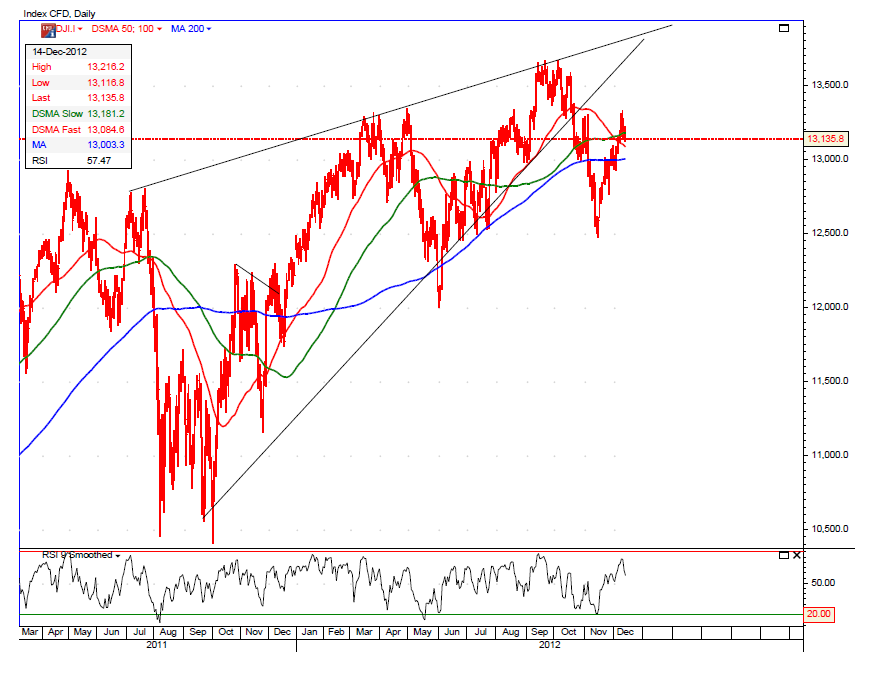

click chart for a better view.
apple chart has a typical head n shoulder formation, it wont be long before it falls deeper, read this blog on earlier discussion of the final settlement pricing of apple. there could be some struggling usually at the neckline 520 which has now been broken. if apple stays below 500 for three weeks or more, not a good sign.
the dow is also not looking to reach new highs above 14000 given the formation of a rising wedge which can bring dow down much harder, the pullback has already occurred, thus it is not likely to go up much higher.
economy will go slower no matter fiscal cliff or not as it will cut into consumer spending one way or the other, this is why there is such a rush to QE to avoid economy contracting too fast once it is over the cliff or a deal is struck to limit expenses and raise taxes.
gold prices is telling the same story that even current QE cannot sustain prices above 1700. it usually is a precursor of the price of oil, it has done poorly for the past few months, my hunch is oil will fall further and gold may go down with it.
22 November 2012
Link Reit, Hysan, HK Real Estate

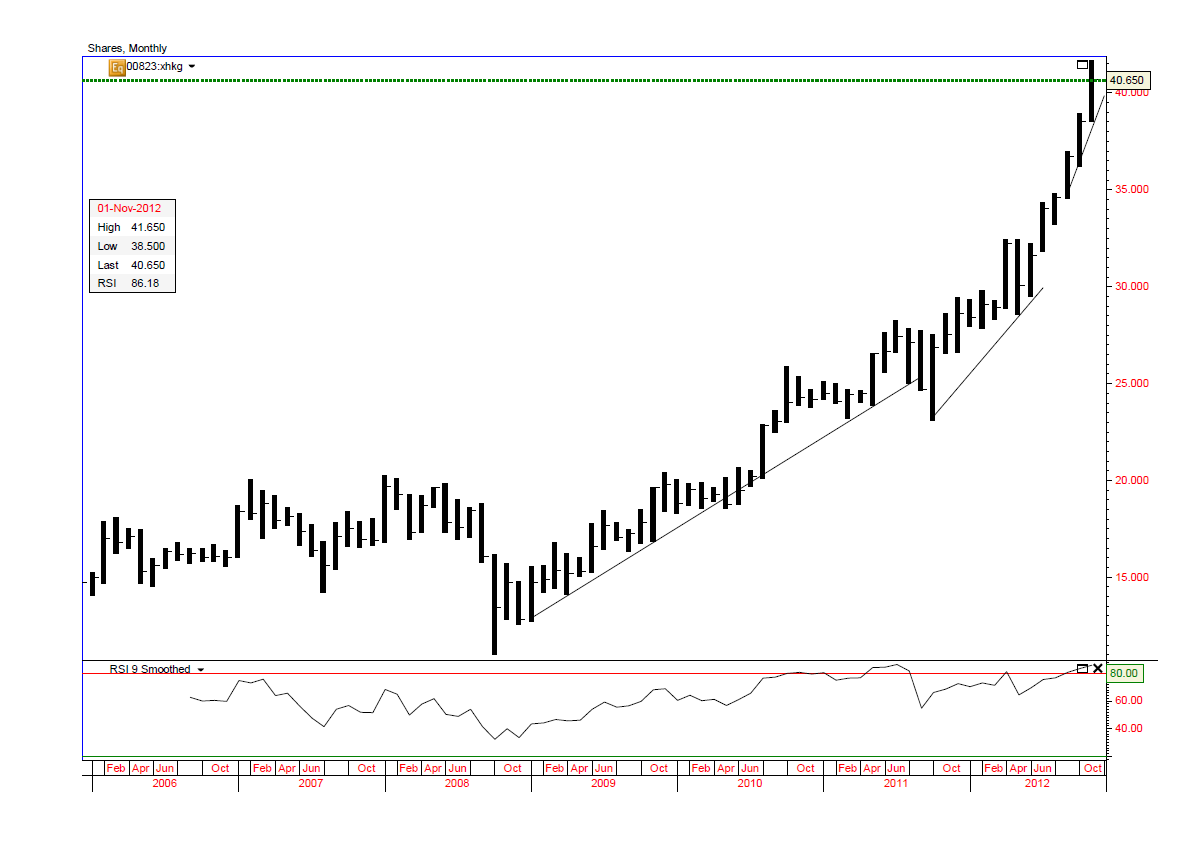
the link reit may be peaking out soon, the three phase of rising trend is exhausting the buying power.
now look at hysan, it looks like there is a rising wedge forming which could lead to a drastic fall if it does not break away from the rising wedge soon ie shooting up past 37.
both companies are similar in nature only that link still has more room for growth and improvement to its 30 years old portfolio.
my hunch is it will happen in less than 6 months.
another indication that real estate might be reaching a peak is that
- the new duties BSD and SSD will have a hard impact on residential transactions while channeling funds to commercial realty and car parks which recently has reached into stratosphere
- BSD will take away the support for the market when it falls and SSD prevents marginal buyers purchasing apartments although prices might then become more reasonable but their jobs are now at risk
- on QRW alone between Possession Street and Queen Street which is only might be a 100m long, there are more than 5 property agents on street level, also an indication that this will not be long before a set back is on the way or might be round the corner already.
17 November 2012
Apple and Dow, HSI


click on chart for a better view
not long back, we talked about apple, now it is apple again, why?
because it was predicted earlier that apple will soon top out, now it has fallen 20% from peak price, it is likely to hit bottom soon and will end the recent dow fallout.
the reverse [downward] rsi vs the price uptrend spells trouble for apple and the fallout is real fast, but rsi is now hitting low range and will soon rise or stay flat.
then where will it land?
looking at the chart, the year began with apple at 426 and rose almost 70%, so anyone who own apple will have their shares grown 70%+ if they have not sold their shares in the past year end.
if it is going to form a head shoulders pattern, it has reached the neckline, my hunch is between 30%-40% from top ie 420-490. last price is 527.
watch out for a rising rsi vs a price downtrend to confirm the uptrend breakout, just like the downtrend breakout.
as there is a lot of speculation that the capital gains tax will rise from the current 15% back up to previous level of 20% in 2013, but a more likely scenario is 28% which has been the case for a long time in history at this level. if you hold stocks like apple with plenty of profits in hand, you would like the profits be taxed at 15% not 28%, this is one reason why apple has fallen so hard and dow's 1000 pt fall. we have seen tons of big wig investors unloading, one from facebook's board selling more than half his angel investments, lucasfilm owner selling out to disney, a key investor sold all his hp shares.
some guys will buy back their shares if the stock is a good one and hard hit. hp is not among it though.
in hk, we will soon have picc going for ipo, the dates are 22 nov to commence ipo applications and 5 dec listing, this may soon spell the end of the hsi downtrend.
Subscribe to:
Posts (Atom)

 Posts
Posts

